


“Wine cheers the sad, revives the old, inspires the young, and makes weariness forget his toil.” Lord Byron
Cape Town has many iconic attractions on offer to tourists but the biggest draw-card has to be our wine farms which produce some of the world’s best wines. With around 550 wine farms in the Western Cape, spread across four main regions, we can certainly offer visitors a wide of choice of superb wines.
Situated in the Western Cape Province of South Africa, the Cape Winelands is the largest wine-producing region in South Africa and is divided into four main regions. Constantia, Stellenbosch, Franschhoek, Paarl, Robertson and Wellington are the most popular wine routes but the oldest grape growing and wine producing area is much closer to Cape Town, nestled in the Constantia Valley.
The oldest wine estate in the Constantia Valley is Groot Constantia. The land was granted to Simon van der Stel, the then VOC Governor of the Cape of Good Hope, in 1685 and he built the historic gabled manor house which is still a must-see attraction for tourists. Van der Stel not only grew grapes and produced wine but also planted fruit and olive trees, vegetables gardens and farmed cattle on his estate with its breathtaking views of the Constantiaberg Mountain. When Van der Stel died in 1712, the estate was broken up and sold as three separate farms: Groot Constantia; Klein Constantia and Bergvliet.
The Constantia portion of the estate, including the manor, was sold to the Cloete family in 1778 and they are credited with making the Constantia wines famous across Europe. Cloete produced mainly an unfortified dessert wine which became a favourite of European kings and emperors from Frederick the Great to Napoleon. One such red is mentioned in a Jane Austen novel!
Sadly the vineyards were destroyed by phylloxera (microscopic, pale yellow sap-sucking insects, related to aphids, that destroy the root systems of the grapes) and the Cloetes, now bankrupt, had to sell their beloved Groot Constantia to the government who used it as an experimental wine and agricultural estate. A devastating fire in 1925 completely destroyed the original manor but, after funds were raised, the house was restored to its original Cape Dutch splendour in 1925.
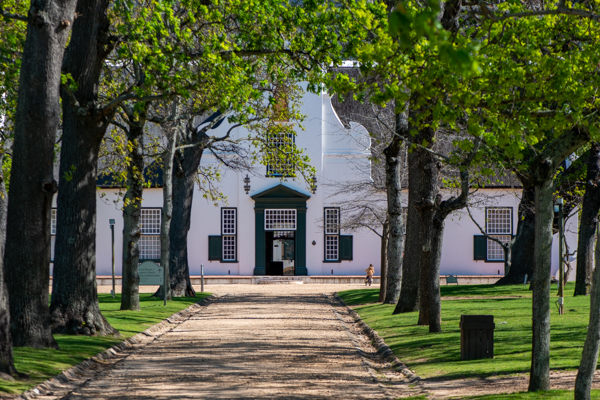
In 1969 the manor house became part of the South African Cultural History Museum and in 1993 passed into the ownership of the Groot Constantia Trust. Wines are produced and tourists can book tastings through their website, as well as explore the house, estate and grounds. Other historic estates on the Constantia Wine Route include Klein Constantia, Buitenverwachting, Constantia Uitsig, Steenberg, Constantia Glen, Eagles Nest and High Constantia; many boasting world-class restaurants and all worth visiting for their superb wines.
Constantia Vally may be the oldest wine producing region but Franschoek could be said to be the jewel in the crown. Situated in a spectacularly beautiful valley, surrounded by the Franschoek and Drakenstein Mountains, the village has over 30 wine farms. It was settled over 300 hundred years ago by the French Huguenots and produces some of the Capes’ most famous labels. It is situated approximately 75 kilometres outside of Cape Town; about a 45 minute drive.
When, in 1685, King Louis XIV began persecuting Protestants in France, hundreds of French Huguenots were forced to flee and arrived at the Cape of Good Hope and were granted the Franschhoek Valley to settle in. They brought with them their French culture and a talent for wine-making and the area became known as Le Coin Francais or the ‘French Corner’ This soon changed to the Dutch translation of Franschhoek (also meaning French Corner), although their vineyards have retained the original French names, such as La Motte, Champagne, La Cotte, Cabriere, La Provence, Bourgogne, La Terra de Luc and La Dauphine among others. These were some of the earliest wine farms to be established and still retain their Cape Dutch-style manor homes today. Many surnames in the area bear their French heritage – such as Du Toit, Marais, Du Plessis and Joubert.
Holiday visitors will never find themselves short of places to explore, attractions to visit and, best of all, magnificent wine estates, within easy driving distances, where one can enjoy the pleasures of superb food and relax with a glass or two of an elegant locally produced wine.

